WASHINGTON, DC – On Thursday, Andy Black, Liquid Energy Pipeline Association (LEPA) President and CEO, testified before a pipeline safety hearing of the Senate Committee on Commerce, Science and Transportation. The Subcommittee on Surface Transportation, Freight, Pipelines, and Safety held a hearing titled Pipeline Safety Reauthorization: Ensuring the Safe and Efficient Movement of America and heard testimony from representatives of liquids and natural gas pipeline operators, as well as pipeline safety advocates.
LEPA CEO Andy Black Testifies at Senate Hearing on Pipeline Safety
WASHINGTON, DC – On Thursday, Andy Black, Liquid Energy Pipeline Association (LEPA) President and CEO, testified before a pipeline safety hearing of the Senate Committee on Commerce, Science and Transportation. The Subcommittee on Surface Transportation, Freight, Pipelines, and Safety held a hearing titled Pipeline Safety Reauthorization: Ensuring the Safe and Efficient Movement of America and heard testimony from representatives of liquids and natural gas pipeline operators, as well as pipeline safety advocates.
“Smart pipeline policies will promote the pipeline energy infrastructure needed to deliver American energy dominance,” said Andy Black, LEPA President and CEO.
Black shared analysis of federal data publicly available from the Department of Transportation’s Pipelines and Hazardous Materials Safety Administration (PHMSA) showing total liquids pipeline incidents are down 13% over the last 5 years. Liquids pipeline incidents Impacting People or the Environment (IPE) are also down 13% over the last 5 years.
Black also emphasized how pipelines are the safest way to deliver the large amounts of energy the American public needs and wants. A 2018 report prepared for Congress by PHMSA analyzing 10 years of incident data found pipelines were 13 times safer than both trains and trucks with pipelines experiencing 1 incident for every 720 million gallons delivered and rail incidents occurring every 50 million gallons delivered. An Obama administration analysis found rejecting a major pipeline and shipping the same crude oil by rail would increase the risk of oil release by over 800 times and barrels released by 2.6 times.
Congress is reviewing the current state of pipeline safety in America as it considers updates to federal pipeline safety law. LEPA urges a pipeline safety reauthorization bill that leverages safety technology & knowledge, supports American energy and improves PHMSA safety programs.
LEPA represents pipeline owners and operators delivering transportation fuels like gasoline, diesel, and jet fuel, transportation feedstocks like crude oil, home heating fuels like propane and home heating oil, industrial feedstocks like ethane and butane, and low carbon solutions like renewable diesel, liquified petroleum gas and carbon dioxide. LEPA has over 50 member companies delivering over 20 billion barrels annually across a nearly a 230,000-mile network of pipelines.
####

Testimony of Andrew J. Black
President & CEO
Liquid Energy Pipeline Association
before the
Senate Committee on Commerce, Science & Transportation
Subcommittee on Surface Transportation, Freight, Pipelines, and Safety
Hearing on “Pipeline Safety Reauthorization: Ensuring the Safe and Efficient Movement of American Energy”
May 15, 2025
Thank you, Chair, Ranking Member, and members of the subcommittee. My name is Andy Black and I am President and CEO of the Liquid Energy Pipeline Association. LEPA represents pipeline owners and operators delivering transportation fuels like gasoline, diesel, and jet fuel, transportation feedstocks like crude oil, home heating fuels like propane and home heating oil, industrial feedstocks like ethane and butane, and low carbon solutions like renewable diesel, liquified petroleum gas and carbon dioxide. We have over 50 member companies delivering over 20 billion barrels annually across a nearly a 230,000-mile network of pipelines.
Thank you for holding this hearing today and highlighting the vital role this Committee has promoting the infrastructure that leads to American prosperity. Liquid energy pipelines deliver transportation fuels like gasoline, diesel, and jet fuel that families, commuters, businesses and travelers use to drive and fly where they need to go. Pipelines deliver transportation fuel feedstocks like crude oil and industrial feedstocks like ethane, propane and butane to make everything from plastics to pharmaceuticals, cosmetics, paints and fabrics. Rural home heating and agricultural fuels like propane delivered regionally by pipeline before traveling locally by truck heat rural homes and farms, dry crops after harvest, and keep livestock barns warm throughout the winter.
Every constituent of every member of this Subcommittee in some way depends on pipelines to meet the needs of their daily lives. From Alaska to Mississippi, from Massachusetts to New Mexico, even in Hawaii, Americans benefit from pipeline delivered energy. Pipelines deliver energy from where it is produced, especially in states like Alaska, Texas and New Mexico, to where that energy is turned into useful products, like refineries in Texas, Indiana, Mississippi, Ohio, Illinois and New Jersey.
Different liquids pipelines then carry those refined products to local regions across America. Pipelines serving America cross states like South Dakota, Nebraska, Missouri. Even if energy products travel those last miles by truck or ship to states like West Virginia, Hawaii or Massachusetts, that energy had to travel at some point on a pipeline.
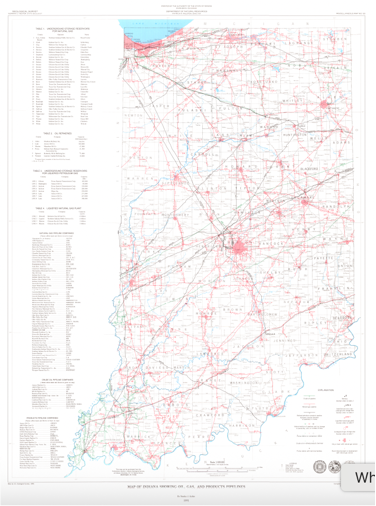
Indiana, the Subcommittee Chair’s home state, is a terrific example of the importance of pipelines. As a crossroads for America, Indiana is also a crossroads of pipelines. Crude oil pipelines cross Indiana to deliver to refineries in Gary, Mt Vernon and neighboring Ohio and Michigan. Refined products pipelines deliver gasoline, diesel and jet fuel from these refineries to major population areas across Indiana. Natural gas liquids pipelines deliver propane from as far away as Texas to homes across rural Indiana. Pipeline delivered propane is also vital to the farmers of Indiana keeping barns warm in the winter and drying crops after harvest. LEPA member companies operating pipelines in Indiana include BP, Buckeye, Citgo, Enbridge, Enterprise, Explorer, Flint Hills, Marathon, Kinder Morgan, Energy Transfer, Tallgrass, Valero and Wolverine (click on map image for link to view file).
When thinking about energy, the American people, including those in Indiana, tell us what they care most about is safety, followed by affordability and reliability. Each year, LEPA commissions a nationwide poll of public sentiment on energy and pipelines. The American public’s preference for safe energy supports this Committee’s work to reauthorize federal pipeline safety law.
As the Committee considers the role of pipeline infrastructure and what changes to make to federal pipeline safety laws, it is important to remember pipelines are the safest way to deliver energy. More than 99.999% of crude oil and petroleum products delivered by pipeline reaches its destination safely.

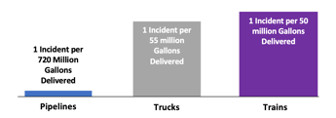
A 2018 report prepared for Congress by PHMSA analyzing 10 years of incident data found pipelines were 13 times safer than both trains and trucks with pipelines experiencing 1 incident for every 720 million gallons delivered and rail incidents occurring every 50 million gallons delivered. An Obama administration analysis found rejecting a major pipeline and shipping the same crude oil by rail would increase the risk of oil release by over 800 times and barrels released by 2.6 times.
Current PHMSA pipeline incident statistics also show pipeline safety is improving. Federal law and regulations require operators to report pipeline incident data to PHMSA. Full year data for 2024 is now available, which allows us to examine current trends in pipeline safety.
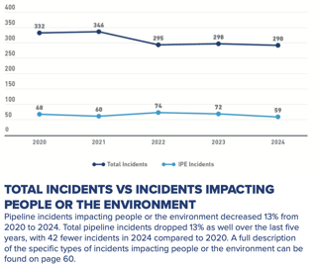
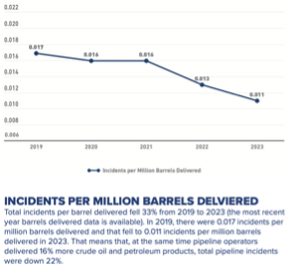
According to publicly available PHMSA data, total liquids pipeline incidents are down 13% over the last 5 years. Liquids pipeline incidents Impacting People or the Environment (IPE) are also down 13% over the last 5 years. When comparing incidents to volume delivered, the decrease is even more striking, with liquids pipeline incidents per barrel delivered down 33% over the preceding 5 years. Or put another way, liquids pipeline incidents are decreasing at the same time America’s pipelines are delivering more and more energy.
These safety metrics are available in a new report, the API-LEPA 2024 Pipeline Performance Report & 2023-2025 Pipeline Excellence Strategic Plan. Each year, LEPA and API download PHMSA incident data to check on how we are doing, where we are doing well and where we need improvement. Those areas of need, both appearing in the data and collected through engagement of our stakeholders, help guide industry-wide safety initiatives. In this report, you can see how the liquids pipeline industry is addressing key challenges like corrosion, leak detection and geohazards. You can see how operators are improving pipeline by harnessing new technologies, artificial intelligence, safety management systems and new recommended practices. You can also see how we are trying to do better on public engagement, cybersecurity, conservation and attracting our future workforce.
Declining pipeline incidents over the last 5 years supports a measured approach to reauthorizing pipeline safety laws without major changes or new mandates. LEPA does believe Congress can do more to help modernize pipeline safety programs. Hi-tech inspection and analytical tools, like an MRI or ultrasound in the doctor’s office, are available for pipeline safety. Analytic methods harnessing machine learning and other forms of artificial intelligence can help operators digest data to show when a pipeline might be leaking or when it needs new maintenance. However, key parts of PHMSA safety regulations are over 20 years old and do not reflect the latest advances in safety technology or know-how.
LEPA also recognizes that America is blessed with an abundance of energy. Pipelines are the vital link from where that energy is produced, to where it is refined into usable products, and on to consumers and businesses in their home regions. Smart pipeline policies will promote the pipeline energy infrastructure needed to deliver American energy dominance. Lastly, LEPA believes Congress can help PHMSA increase the effectiveness and transparency of its pipeline safety programs and requirements. The administration is proposing regulatory actions to help PHMSA become a smarter, more efficient, more modern regulatory agency and Congress can support those efforts.
LEPA welcomes pipeline safety reauthorization provisions that would:
- Reform PHMSA’s Special Permit program to impose permit review shot clock and limit unrelated permit requirements
- Strengthen penalties for pipeline safety violations that impair operation of facilities or damage construction sites
- Fulfill the 2020 Congressional mandate of a safety program for idled pipelines
- Reauthorize without extraneous conditions a PHMSA technology demonstration pilot program
- Provide defendants the opportunity for a formal PHMSA hearing, and protect security or commercially sensitive information presented as evidence in PHMSA hearings open to the public
- Authorize a Voluntary Information Sharing program to convene stakeholders to collaborate on safety initiatives, similar to FAA’s successful program
- Allow risk-based inspections of in-service breakout tanks to reduce unnecessary greenhouse gas and air pollutant emissions, worker safety threats, and hazardous waste when shown to achieve an equivalent level of safety
- Increase the transparency of PHMSA inspection program with reporting on inspection priorities, dates and locations
- Require PHMSA review of consensus safety improvement standards
- Provide a targeted update of federal CO2 pipeline requirements to extend regulatory coverage to gaseous CO2 and require CO2-specific incident dispersion modeling (topography, weather, operating conditions, trace compounds)
An additional note on leveraging new technologies that provides a case study on the frustrating reality of bureaucracy and red tape in government. In the 2020 PIPES Act, Congress recognized pipeline safety could benefit from harnessing the latest hi-tech inspection technologies and analytics. As I mentioned, there’s so much modern technology and analytics like artificial intelligence can benefit pipeline safety. Congress authorized PHMSA to conduct a pipeline safety technology demonstration pilot program under certain conditions.
However, in implementing the technology demonstration program, PHMSA under the previous administration imposed a host of additional administrative, regulatory and legal conditions beyond what Congress itself mandated. As a result, PHMSA received no applications to conduct technology pilots and the program sunseted. Pipeline operators cited the additional conditions PHMSA imposed in its implementation guidance as making the program infeasible. PHMSA bureaucratic red tape effectively strangled this program in its crib. An opportunity now exists and LEPA supports restoring the will of Congress and reauthorizing this program without additional bureaucratic red tape or conditions.
Thank you again for the Committee’s support of pipeline energy infrastructure and the opportunity to testify before you today on the benefits of pipelines, including their safety.
####